
The department of telecommunication has decided that the existing variable licence fee structure for telecom operators should be replaced with a uniform one. An departmental note suggests a uniform licence fee of 8.5 per cent for all types of services.

Limited monopoly period to airline bidding for least subsidy to connect any of 80 Tier-III cities.

While the company insisted it had enough spectrum across circles, analysts said the company might soon need to acquire some spectrum to ensure uninterrupted service.


It is learnt that the defence ministry is refusing to let go of its 100 MHz spectrum, which was allotted earlier. In that case, the department of telecommunications (DoT) will be left with only 175 MW of 5G spectrum of the total 300 MHz.

The JV between the two has won BWA spectrum in Delhi, Mumbai, Haryana and Kerala.

The fear that Mamata might snatch the mantle of Opposition leadership which the Gandhis firmly believe to be theirs by birthright seems to have persuaded Sonia and Rahul to give up their hoity-toity ways, observes Virendra Kapoor.
According to sources, various players specialising in e-auction like Deloitte, Metal Junction (it specialises in e-auctions for steel manufacturers and allied industries), Spiderboon Internet Service Pvt Ltd (an e-auction and e-tender service provider), N M Rothschild and Sons (investment banking and advisory firm) were represented.

Corporate affairs ministry note for ministerial group says can't keep banking, telecom out of CCI purview as RBI, Trai enable but not regulate competition
While Reliance/Infotel Broadband stands to gain if Qualcomm is forced out of the BWA race, will the potential Indian consumer of broadband wireless services gain from this unseemly tussle? That is a question that remains unanswered.
Currently, ISPs pay only Re 1 as annual licence fee while Internet telecom service providers, or telecom operators providing Internet services, pay 6 per cent of their annual gross revenue as licence fee.

Newer telecom operators and dual technology entities are opposing the department of telecommunications (DoT)'s decision to ask the Telecom Regulatory Authority of India (Trai) to give its view on whether the price of spectrum being offered in the coming 2G auction should be valid for 10 years instead of 20 years.
Following is the chronology of the events in the 2G spectrum allocation scam in which the prime accused and former Telecom Minister A Raja was on Tuesday granted bail:
Etisalat, which is mulling an Indian foray, has since started discussions with several telecom companies including the Videocon Group's Datacom Solutions and Essar-controlled Loop Telecom for equity. Ravi Sharma, CEO of Datacom confirmed that Etilasat was one of the companies to which the company was talking but declined to offer details. Loop Telecom declined to comment.

Going by the guidelines issued in August 2007, the ISP licence was valid for 15 years and the one-time entry fee was Rs 20 lakh (Rs 2 million) and Rs 10 lakh (Rs 1 million) for Category-A and category-B circles, respectively. The new amendments will come into effect immediately.
The Ministry of Corporate Affairs has asked the Department of Telecommunications to reconsider its decision to issue Mumbai-based Loop Telecom an all-India mobile services licence, suggesting the company had links with Essar Group that violate restrictions on telecom cross-holdings by groups.
Defence officials contend that the services do not use spectrum for 'commercial purposes' and therefore do not need to pay for it.

Qualcomm had received its internet service provider licence last month, after a delay of 18 months, with a validity period of 20 years after a Telecom Disputes Settlement and Appellate Tribunal direction to DoT.
Communications solutions and services provider British Telecommunications' (BT) Indian arm, BT India (BTI), on Tuesday said it will invest 375,000 pounds (about $558,418) for setting up its Asia Pacific security operations centre (SOC) in the country.
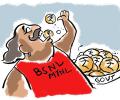
'BSNL employee cost is Rs 14,500 crore and we anticipate that around 80,000 should opt for VRS.'
The Department of Telecommunications (DoT) has selected NYSE-listed Syniverse Technologies as one of the two companies to implement mobile number portability (MNP) services in the country.

Government websites -- including those of the Prime Minister's Office, home and petroleum ministries, and the department of telecommunications -- were out of service for many hours on Monday. An official attributed the cause to firewall problems.

Job portals like Monster.com and Naukri.com affirmed the observation.

The ministry wanted to use spectrum in the 700-MHz band for mobile TV services.
The move will deprive millions of the freedom to choose service providers without changing their phone numbers.

Downloading songs, movies, books? You may have to pay tax on it.

Telecom regulator TRAI on Tuesday released a detailed consultation paper to discuss threadbare the modalities for auction of spectrum across multiple bands, including pricing, quantum and other conditions -- preparing the groundwork for 5G auctions slated for next year. Trai's comprehensive consultation paper runs into 207 pages and throws up 74 questions for industry-wide discussion, touching on crucial aspects like valuation and reserve price of spectrum, including 5G, quantum of spectrum, block size, eligibility conditions for participation in auction, roll-out obligations, spectrum cap, and surrender of spectrum. Norms will also be worked out for new frequencies such as 526-698 MHz and millimetre band, that is 24.25 - 28.5 GHz, in addition to bands such as 700 MHz, 800 MHz, 900 MHz, 1800 MHz, 2100 MHz, 2300 MHz, 2500 MHz, 3300-3670 MHz.

'Whoever owns the best chip industry will be the Saudi Arabia of the era of data,' predicts Rajeev Srinivasan.

The Department of Telecommunications is planning to give more powers to the telecom regulator, Telecom Regulatory Authority of India, in the new telecom policy, including the power to impose financial penalties on the erring telecom service providers.
The defence ministry has signed a memorandum of understanding with the Ministry of Communications and Information Technology under which the armed forces will immediately release 10 MHz of 3G spectrum and 5 MHz of 2G spectrum.
Will scrap bid if it falls below government's revenue expectations.
However, portability services, which were earlier expected to be launched by the end of the year in the four metros -- Delhi, Mumbai, Kolkata and Chennai -- as well as Tamil Nadu, have now been delayed till February or March 2009 (the DoT has said that it will start operations six months after the licence is granted).
Following is the chronology of events in the 2G scam.

A high power satellite, GSAT-15 is being inducted into the INSAT/GSAT system. GSAT-15 carries a total of 24 communication transponders in Ku-band as well as a GPS-Aided GEO Augmented Navigation (GAGAN) payload operating in L1 and L5 bands.

Prime Minister Narendra Modi on Wednesday said the government has no business to be in business and his administration is committed to privatising all PSUs barring the bare minimum in four strategic sectors. "It is government's duty to support enterprises and businesses. But it is not essential that it should own and run enterprises," he said. Modi also said the Centre's policy is to either monetise or modernise public sector enterprises, with the intent that the government has "no business to be in business".
British Telecommunications (BT) has received both international long distance (ILD) and national long distance (NLD) licences that will enable it to offer telephony services in the country.

In May, Trai had gave its recommendations on a 'Spectrum Management and Licencing Framework', in which it had said that consequent to the merger of licences in a service area, the total spectrum held by the resultant entity post-merger shall not exceed 12.4 MHz for GSM technology, or 10 MHz in case of CDMA technology.

The recommendations on the subject will be sent in due course to the government, according to an internal communication of DoT
